 Skip to content
Why O’Hare Airport Transportation Gets Delayed ?
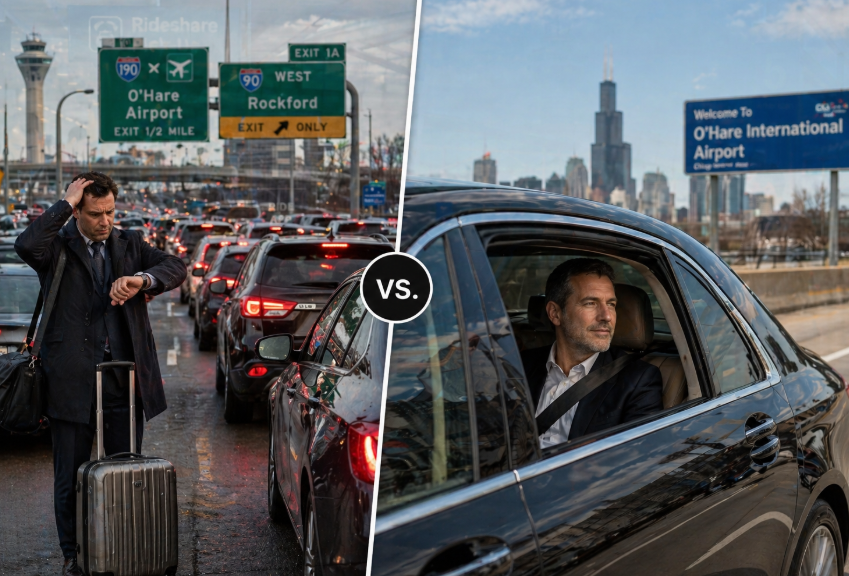
Reliable O’Hare airport transportation can help travelers avoid traffic delays, missed flights, and last-minute stress when traveling through Chicago. To avoid delays when traveling to O’Hare Airport, leave 25–40% earlier than your estimated travel time, avoid peak traffic hours (7–10 AM and 4–7 PM), and check live traffic updates before departure.
Why Does O’Hare Airport Transportation Get Delayed?
Most delays are not caused by one major issue. They usually come from a series of small, avoidable mistakes.
People tend to rely on navigation apps without questioning them. They assume the displayed travel time reflects reality, but those estimates often don’t fully account for sudden congestion, construction slowdowns, or airport traffic near terminals.
Another common issue is timing. Travelers leave based on when they should leave in perfect conditions, not when they realistically need to leave to stay safe. Add in a late ride, a crowded drop-off lane, or a small traffic buildup, and suddenly the margin disappears.
Delays are rarely random. They follow patterns—and once you understand those patterns, you can plan around them.

Quick O’Hare Airport Transportation Tips
- Leave at least 25–40% earlier than your expected travel time
- Avoid peak traffic hours when possible
- Check live traffic before leaving
- Book transportation in advance for important trips
- Add 10–15 minutes for airport drop-off delays
- Adjust timing for weather and busy travel periods
How Early Should You Leave for O’Hare Airport Transportation?
For reliable O’Hare airport transportation, you should leave earlier than your expected travel time to avoid traffic delays and airport congestion.
For example, if your usual drive to O’Hare takes 50 minutes, you should plan for at least 65–75 minutes. During peak hours or bad weather, increasing that buffer even further is a smart decision.
It’s important to think beyond just the drive. You also need to account for:
- entering the airport
- reaching your terminal
- unloading luggage
- getting to check-in or security
Arriving early gives you control. Leaving too late removes it.
What time of day is traffic worst in Chicago?
Traffic in Chicago follows predictable patterns, but many travelers ignore them.
Weekday rush hours are the most consistent problem:
- Morning: 7 AM to 10 AM
- Evening: 4 PM to 7 PM
During these times, travel time can increase significantly, even on routes that are usually fast.
However, weekends are not always better. Events, airport traffic, and general city activity can create congestion throughout the day.
If your trip overlaps with any busy period, you should automatically assume delays and adjust your departure time.
How much buffer time is actually enough?
Many people add “a little extra time,” but not enough to make a real difference.
A practical guideline is:
- 15–20 earlier minutes for short trips
- 25–40% extra time for longer drives
- additional time during peak traffic or bad weather
The goal is not to be exact—it’s to be safe. A slightly longer wait at the airport is far better than rushing or risking a missed flight.
Book Reliable O’Hare Airport Transportation in Chicago
Your transportation choice plays a bigger role than most people think.
On-demand options like rideshare are convenient, but they introduce uncertainty. Drivers can cancel, arrive late, or take inefficient routes. During high-demand periods, even getting a driver can take longer than expected.
Taxis are generally available, especially at the airport, but the experience can vary. Vehicle condition, driver familiarity with routes, and overall efficiency are not always consistent.
Pre-scheduled transportation removes many of these variables. When your ride is arranged in advance, timing is planned, drivers are assigned ahead of time, and adjustments can be made based on traffic or flight changes.
If your timing is important, reducing uncertainty should be a priority. A reputed Chicago limo service serves the purpose.

Should you book transportation in advance?
Yes, especially if your trip is time-sensitive.
Last-minute bookings often rely on availability rather than planning. This means you are dependent on:
- nearby drivers
- current demand
- traffic conditions at the time of booking
Booking in advance shifts the process from reactive to planned. It gives you a clearer timeline and reduces the risk of delays caused by availability issues.
For early morning flights, late-night travel, or busy travel periods, this becomes even more important.
Should you check traffic before leaving?
Absolutely. Even if you planned your trip earlier, conditions can change quickly.
Checking live traffic 15–20 minutes before leaving helps you:
- identify congestion
- spot accidents or road closures
- choose better alternate routes
This step takes very little time but can prevent major delays. It also gives you the option to leave earlier if conditions worsen.
Avoid Stress With O’Hare Airport Transportation Services
Even with planning, unexpected delays can still happen. The key is how you respond to them.
If you encounter traffic:
- stay calm and avoid aggressive driving decisions
- follow navigation updates if they suggest alternate routes
- monitor how much time you are losing and adjust expectations
Having buffer time is what allows you to absorb these delays without panic. Without it, even small disruptions feel much bigger.
How long does it take to get through airport drop-off at O’Hare?
The final stretch near O’Hare is often underestimated.
Once you approach the airport, traffic tends to slow down due to:
- merging lanes
- terminal congestion
- heavy passenger drop-off activity
Drop-off lanes themselves can be crowded, especially during peak travel hours. Even after arriving, it may take additional time to unload luggage and reach the terminal entrance.
You should plan for at least 10–15 extra minutes for this part of the journey.
How does weather affect travel time to O’Hare?
Weather has a direct and significant impact on travel time in Chicago.
Rain reduces visibility and slows traffic. Snow and ice create even greater delays, often causing congestion across multiple routes. Wind can also affect driving conditions, especially on open roads.
During poor weather:
- traffic gets slower
- accidents are common
- delays spread across the city
Checking the forecast before your trip allows you to adjust your timing early instead of reacting too late.
What are the biggest mistakes to avoid?
Most delays can be traced back to a few common mistakes.
- Leaving based on minimum travel time
- Not accounting for traffic patterns
- Booking transportation too late
- Ignoring airport-side delays
- Underestimating weather impact
Avoiding these mistakes doesn’t require complex planning—just better awareness.
What is the safest way to avoid delays completely?
The safest approach is to plan for real conditions, not ideal ones.
A simple strategy that works consistently:
- Leave earlier than necessary
- Add buffer time for traffic and airport congestion
- Choose reliable transportation for important trips
- Check live conditions before departure
- Adjust based on traffic and weather
This approach removes uncertainty and gives you control over your schedule.
Final takeaway
Avoiding delays when traveling to O’Hare is not about luck. It comes down to preparation and realistic planning.
When you account for traffic, timing, transportation, and airport conditions together, you reduce the chances of delays significantly. A little extra time and the right decisions can turn a stressful trip into a smooth one.
Getting to the airport on time should feel routine, not rushed. With the right approach, it can be.
